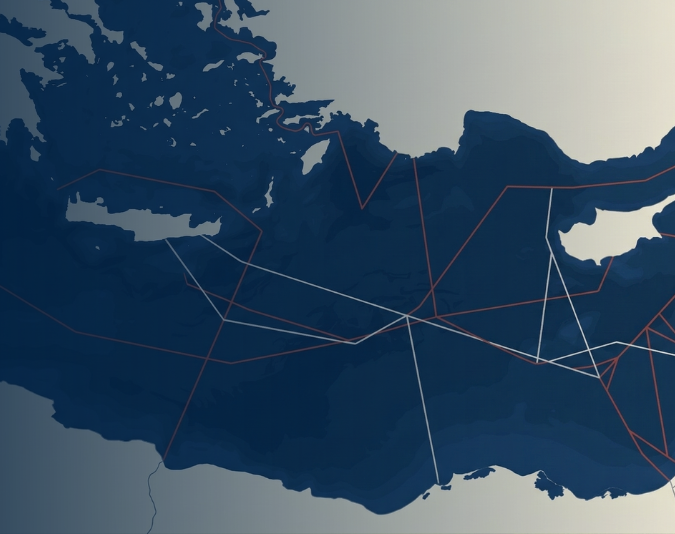
The Eastern Mediterranean Sea is one where many interests are at stake, especially those of whose overlapping maritime claims meet, as it is the historical case of Turkey and Greece, with new players involving themselves: Egypt & Libya.
Every conflict has its history, and this one starts in 1923 with the signing of the treaty of Lausanne, which stablished the Greek-Turkish borders after the First World War, with most of the Aegean Islands being transferred to Greece; and in 1947 after the Treaty of Paris (to which Turkey was not a party), when the Dodecanese islands were also transferred to Greek sovereignty. Nonetheless, the main spark of the conflict arose in 1947 when Oil was discovered near Thasos, triggering competition for continental shelf claims. This tensions further intensified with Turkey’s military intervention in the Cyprus Coup of 1974, and the island being divided into the Republic of Cyprus and the Turkish Republic of Northern Cyprus. Finally, around the 90’s, Turkey broadened its sovereignty claims over gray zones such as Imia and Kardak, being the first one recognized as Greek and the latter as Turkish.
Having a look at a closer historical event, in 2019 Turkey and Libya (the UN recognized Government of National Unity – GNU) signed a Memorandum of Understanding to create a corridor that would act as an energy blockade, which ignores the existence and maritime rights of several Greek islands such as Crete, Rhodes and Kastellorizo. Notwithstanding, this is not just a geographical or energetic-driven conflict, but also a geopolitical one, as Turkey militarily supports the GNU in exchange of signing the maritime accord, and on the other side, Egypt backs the Libyan National Army (LNA) and has proposed and alternative energy route: the EastMed Pipeline, along with Cyprus and Israel.
In the face of the MoU between Libya and Turkey, in 2020 Greece and Egypt signed their own Economic Exclusive Zone agreement, delimiting their own maritime boundaries, creating a zone of direct legal conflict. Egypt, on its side, emitted a Presidential decree 595/2022 formally delimiting its western maritime boundaries asserting sovereignty fait accompli. This decree was a strategic countermeasure intended to block the Turkish-Libyan corridor by asserting Egyptian sovereignty over the very waters the MoU sought to claim.
The United Nations Convention of the Sea (UNCLOS) grants states sovereignty over the territorial seas up to a limit of 12 nautical miles, the contiguous zone extends up to 24 nm, and the Exclusive Economic Zone (EEZ), up to 200 nm from the baseline. Greece and Egypt are adhered to this law, firmly defending that the islands have the same right as territorial land to be determined in accordance to the Convention, with this including an equidistance principle-based delimitation (drawing a median line between opposing coasts, following Articles 74 and 83), to which Turkey is firmly opposed, as the Greek islands’ closeness to Turkish territory directly limits its access to the Aegean Sea, thus being a threat to their national security and economic interests.
Turkey does not follow UNCLOS but customary international law, which delimits maritime sovereignty based on the principle on equity and proportionality of the length of the coasts, treating islands as “special circumstances” that should not have full continental shelf nor EEZs, as they shouldn’t cut off a mainland’s natural prolongation, in line with their Blue Homeland doctrine (Mavi Vata).
It is simple: Turkey doesn’t recognize UNCLOS law over the island’s rights of maritime sovereignty, and Greece and Egypt have allied to create their own divided EEZ in order to counterbalance Turkish-Libyan increasing interests over the region.
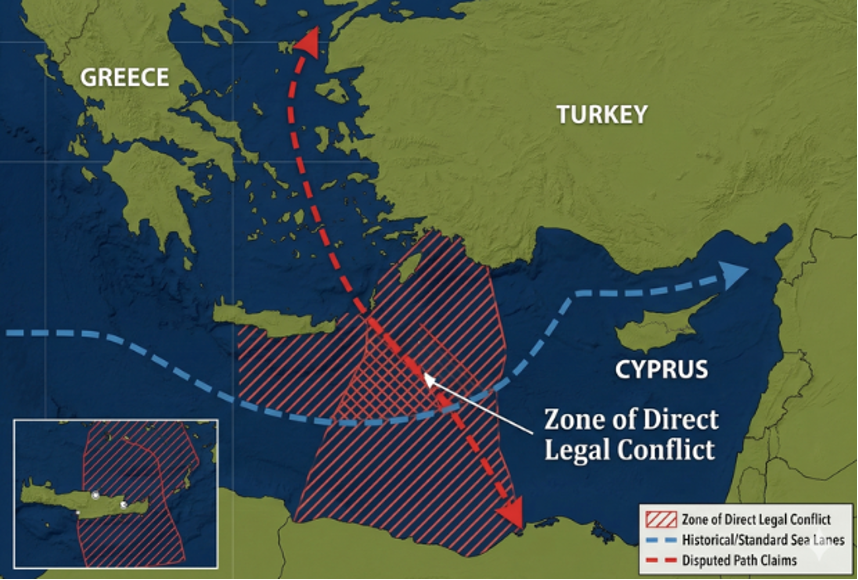
The dispute has escalated significantly in June 2025 with the singing of a Memorandum of Cooperation (MoC) between the Libyan National Oil Corporation and theTurkish Petroleum Corporation (TPAO), authorizing the latter to conduct geological and seismic surveys across for designated areas, within which one of them directly overlaps with the maritime boundaries defined by Egypt’s Presidential Decree 595/2022, meaning that this activity directly violates Egyptian-claimed waters, turning the disagreement into a possible naval confrontation. On the other hand, if Greece were to use its right to declare sovereignty along 12 nm from the islands, Turkey would take this as a casus belli.
The situation is currently at a stalemate as there is a requirement for a mutual agreement that no party is yet willing to sign and having a third-party arbitration is not on the table as Greece in 2015 and Egypt in 2017 rejected mediation in Article 298 UNCLOS.
How will this situation advance in the face of the increasing geopolitical instability, especially in the Middle East?