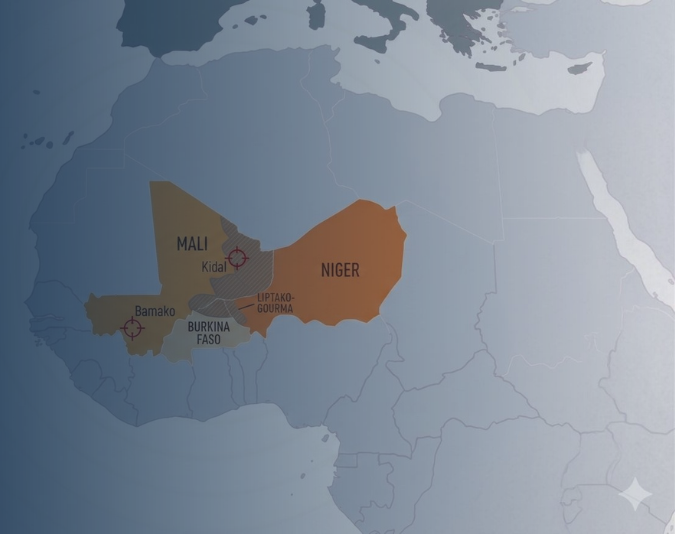
The Sahel is the world’s most affected region by terrorist violence ranking #1 in the Global Terrorism Index. This is due to a combination of characteristics including its landlocked geography, territorial isolation, ethnic and nomadic tensions, extreme poverty rates, dependency on agriculture and imports, amongst other reasons.
In 2023, Mali, jointly with Niger and Burkina Faso created the Alliance of the Sahelian States (AES – “Alliance des États du Sahel”) followed by their withdrawal from ECOWAS in 2025. The region is characterized by its political instability and insecurity, being the epicenter of military coups – more specifically Mali in 2020 and 2021; Burkina Faso in 2022 and Niger in 2023. Amid this political instability, an anti-western sentiment rose, expelling Western military forces from the region, and putting an end to missions such as MINUSMA (2014-2023).
Nonetheless, political breakdown alone is not the main reason for instability, but rather the jihadist expansion that has been taking over control of the region, including groups such as Jama’at Nusrat al Islam wal Muslimeen (JNIM – expanding from Mali into Burkina Faso and Niger, and affiliated to Al-Qaeda); the Islamic State (IS – in the Liptako Gourma area) and also Boko Haram (in the Lake Chad Basin), which have restructured the entire security situation, having in consideration weak state capacity, and their increasing reach on military, economic, political and social matters.
Recent turmoil in Mali raises concerns and challenges of the already weak security situation. It remains the epicenter of the crisis and after the 2020 and 2021 coups d’etat and the withdrawal of French and UN forces, competition over territory greatly intensified. Nonetheless, history explains recent events, as it was as 2010’s when the Tuaregs arrived at the North of Mali right after the Libyan civil war and Gadhafi’s death, creating the Groupe Auto-défense Touareg, Imghad et Allié (GATIA), where the National Movement for the Liberation of Azawad (MNLA) also had prevalence. The recent attacks on Bamako and Kidal have shown that there is a cooperative relationship between the jihadist group JNIM and the separatist group MNLA (“FLA” in English terminology) – the latter seeking the independence of the North, which was taken by the government in 2023, and the former motivated to have sovereignty over the territory.
The western retreat of troops some years ago was replaced in 2021 with Russian mercenaries, initially known as Wagner Group and later renamed as Africa Corps, which would provide security support against terrorist groups in exchange for access to mining sectors. After the attacks of 25 and 26 of April, the Africa Corps were forced to evacuate from Kidal after being taken over by JNIM and MNLA.
What are the geopolitical implications of this situation?
To begin with, there is a new convergence between insurgent and terrorist groups, which further deteriorates the already weakened Government’s sovereignty in Mali. This type of insecurity erodes public confidence in the State, as many people turn to armed groups in exchange for protection.
Moreover, the Africa Corps withdrawal from Kidal has a direct impact on the global perception of Russia being a reliable external security actor. Meaning that Russia, involved in the ongoing Ukrainian war, has its focus diverged, and not only in Africa but also in the South Caucasus after the Nagorno-Karabakh wars. Is Russian hegemony being eroded? Will its presence in Africa be non-welcome as it happened with the West?
Regarding regional cooperation, on January 29 of 2025 the AES withdrawal from ECOWAS was formalized. However, now more than ever joint efforts are needed in order to tackle an increasing regional security crisis that might have consequences in the Sahel, in Africa, as well as in the global spectrum. There has been ongoing collaboration between Mali and Burkina Faso, with Ghana and Senegal on border security, although the fight on terrorism must be multidimensional and extensive and all members of AES should be willing to leave behind past tensions to fight for a future.
Furthermore, there are several reasons why there is a security threat of direct spillover into the European continent. These are: an irregular migration flow from Africa into southern Europe; the expansion of transnational criminal networks including but not limited to arms trafficking; human smuggling; drug routes connecting LATAM-West Africa-Europe; hybrid security threats where instability is exploited by hostile actors to pressure European policymaking…
The situation is still uncertain, it marks a turning point in the geopolitics of the region, and the balance of power is once again being redrawn. What is the international world’s stance on this? Will there be another coup d’état? Will the West be involved in the following events? Has Russia lost legitimacy as the security provider?