
In September 2025, the Ukrainian government announced the opening of the first stage of its new railway line; built in accordance with transport regulations of the European Union, deepening an already growing political and logistical integration with the EU’s network of movement. The newly built track, which had setup costs of almost €29 million, and connects the western cities of Uzhhorod and Chop remains dwarfed by Soviet-era transport networks which still define most of the now at-war nation (EIB, 2025). In a sense, this injection of funds and manoeuvrability operates as more of a performative geopolitical expression of change and distancing than a practical one, building an alternative, tangible, and separate Ukraine that no longer relies on its USSR past, but a Western-orchestrated system of procurement, trade, and critical infrastructure for peacetime rebuilding.
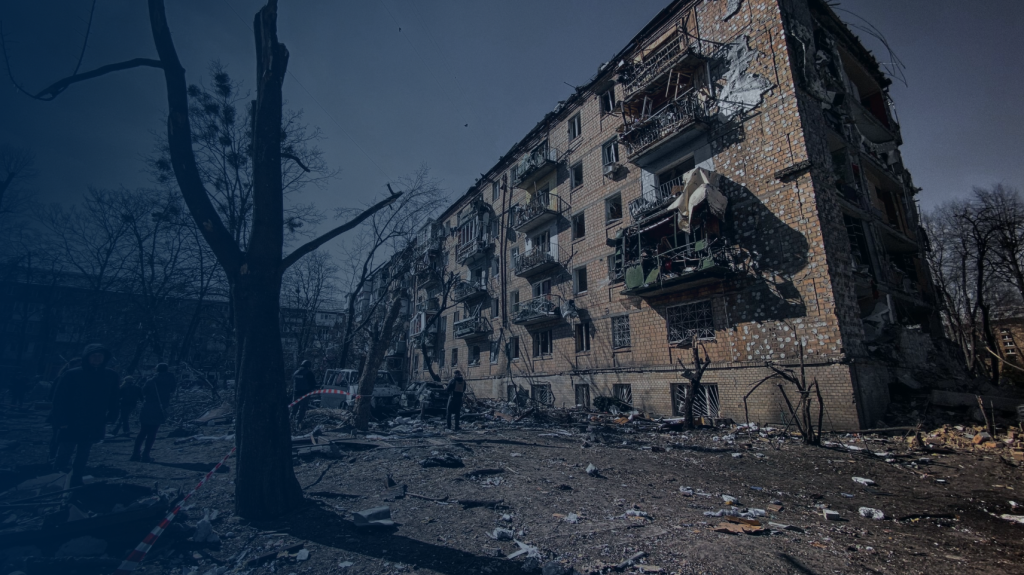
The projected economic costs behind such a national-scale reconstruction project lie around €580 billion over the next 10 years, an amount that dramatically triples Ukraine’s current GDP (World Bank, 2026). Additionally, with direct physical destruction of transport from the Russia-Ukraine war now reaching an estimated $195 billion in reconstruction costs, a year of rising violence and infrastructural destruction is now playing a definitive role in Ukraine’s potential economic and political future. In parallel with these prospects, the European Commission recently announced a €90 billion loan of support to Ukraine, two-thirds of which are being deployed as military assistance (European Commission, 2026). Likewise, as of late 2025, the US Development Finance Corporation has announced the launch of its U.S.-Ukraine Reconstruction Investment Fund, targeting funding of over $150 million across 2026 (DFC, 2025). Indeed, Ukraine’s hypothetical futures have become an accelerating multinational testing ground of economic influence and long term reliance on ideologically polarised states.
On the European side, the architecture of wider infrastructural rebuilding has branched beyond Ukraine’s borders in the form of a €50 billion ‘Ukraine Facility’, a system of Brussels-defined ‘Reform and Recovery Plans’ which build a financial template through a scope of EU-controlled investment. In July 2025 during the Ukraine Recovery Conference in Rome, President of the European Commission, Ursula von der Leyen unveiled a substantial €2.3 billion package of capital investments, including a €160 million loan to Ukrnafta in exchange for 250 megawatts of dispersed gas generation and infrastructural support for highway development (EIB, 2025). As such, Europe’s dictations of Ukraine’s post-war rebuilding are being directly tied to their geographies of resource wealth, industrial prowess, and the needs of its Western supporters. In wider investment terms, 2025 marked a record year for volumes from the European Continent, with key corporate financiers and beneficiaries like Siemens Energy, Thales, and Strabag making long term loan commitments (Global X, 2025). As of 2026, European ties to Ukraine continue to deepen, with the UIF integrating over €5 billion euros in grants and guarantees, drawing Ukraine even further towards an EU-centric future. This is most visible through European rhetoric, which projects such investments as the first steps towards integrating Ukraine into the wider European family.
Washington’s parallel contributions have likewise reached record scales, but in a form that integrates resource wealth in direct demands. In April 2025, the U.S.-Ukraine Reconstruction Investment Fund was established to actualise American financial engagement, while organising mineral guarantees as its post-war compensation (The White House, 2025). For instance, the US Development Finance Corporation has contributed $75 million in exchange for over 50% of national mineral trade profits, including vital wartime materials like oil and gas. Consequently, analysts and external assessments alike have evaluated the initial resource tradings as “lopsided”, drawing comparisons to a post-Great War Germany reconstruction and the unlikely conditions for their repayment (Carnegie, 2025). In similar complications, the agency that provided Ukraine with $5.4 billion in 2024, USAID, was officially dissolved and absorbed into the US State Department, with 83% of its programmes being cancelled (CSIS, 2026). As such, the United States’ financial apparatus continues to adjust from a grant system to a model of investment, loans, and resource equity guarantees for its own potential long-term gain.
However, Western grants and loans have an ideological and economic counterpart which remains commonly under-reported in comparison. On the Russian side, the Kremlin equally conducts its own reconstructions within Ukrainian occupied territories. Since 2022, in unison with its military offensive, the Russian Federation has made strategic efforts in housing redevelopments and infrastructure in Mariupol, as well as wider regions of Donetsk, Luhansk, and Zaporizhzhia; all geographies which were originally invaded and are currently occupied and contested between Russian and Ukrainian forces (Jamestown, 2025). In these zones, newly built apartment complexes have been listed as only available to Russian citizens, forcing Ukrainian residents to concede nationality to claim security and shelter, providing key symbolic victories for Russia’s local image.
Since then, over twenty apartment blocks have been constructed in Mariupol alone, opening the Russian market to similar recovery plans (Bellingcat, 2025). Within this financial injection, Meduza (2025) estimates that rebuilding in its current state could take up to 18 years, with the majority of the contracts flowing within the Rotenburg Network, tying directly to Russia’s oligarchy and fostering a RUB 319 billion project that already has contracts listed until 2027. Within these development plans across Russian-occupied territory, reconstruction of 13 million m² of new housing, 140 kindergartens, and hundreds of km of roads/rails are reportedly already underway. Here, the damage being caused by actors of the Russia-Ukraine conflict is also correspondingly producing and reinforcing the future of Russia’s alternative reconstruction, a divide that is consolidating profound ideological, economic, and increasingly nationalistic differences between broader power networks.
This remains the case for states further afar, such as China, which remain active in external contracting bids from both European and Russian procurement bodies. Without clauses that limit external wartime involvement for the likes of EIB contracts, European organisations like the German Eastern Committee of Economic Relations have directly proclaimed that Chinese firms are quickly absorbing EU contracts, while German taxpayers and institutions underwrite them (Global X, 2025). Indeed, this critical response from within the European Union reveals a system of procurement and loans that is not as neutral or western-facing as presented, but a methodical alignment of industry and finance that separates Ukraine between its donors and negates self-sovereignty.
Likewise, China’s role in Ukraine’s reconstruction planning offers a perspective of nuance, with Ukraine also remaining a key signatory of China’s Belt and Road Initiative, building a contradictory system of support and counter-support internally. In this sense, Beijing is likewise declaring financial participation in the future of post-war Ukraine, while also drawing economic support to its own China International Development Cooperation Agency (The Diplomat, 2025). However, direct Chinese wartime investment has indeed been halted, with Brussels and Washington limiting influence in the production of dual-use technologies, energy infrastructure, and telecommunications. As such, China’s barricade from Ukrainian investment also signifies an external influence on Ukraine, as blocks to financiers and aid come from Washington and Brussels, not Kyiv (MERICS, 2025).
Nevertheless, in November 2025, the infrastructure developed around Ukraine’s reconstruction projects began to show cracks. During these winter months, the National Anti-Corruption Bureau of Ukraine and the Specialised Anti-Corruption Prosecutors Office conducted simultaneous investigations, becoming known collectively as Operation Midas. Within the operation, a $100 million kickback scheme was uncovered from within Energoatom, Ukrainian state nuclear energy provider, revealing a 10-15% skimming scandal on procurement contracts. Importantly, these schemes were allegedly organised by Timur Mindich, long-term collaborator of President Zelensky (NABU, 2025; OSW, 2025). Since the scandal became public, two key ministers have been dismissed while the corporate governance of major procurement providers is now being called into question both within and beyond the state (Kyiv Independent, 2025). Recent attempts to curb these issues since July 2025 have been contested by Ukrainian leadership, citing conditionalities and restrictions on procurement as a pathway to defeat for the nation (Brookings, 2025). Consequently, Ukraine’s web of reconstruction and infrastructural finance reveals a severe degrading national complex both from outside and disconcertingly from within.
In addition, Washington has recently turned frozen financial assets into a strategic position in this orchestrated competition, proposing a channeling of $100 billion of frozen Russian funds into reconstruction while keeping half of its profits. Within this proposition and its adjacent investment platform, the European Union is also being requested to contribute a matched sum of Russian funds (Axios, 2025). Within days of the agreement, the UK, France, and Germany had agreed to raise the funding ceiling for Ukrainian forces, showing further elements of attempts in aligned western advances in wartime financing (Chatham House, 2025). However, this is not to say that internal pushback is non-existent, with Belgium, Hungary, and Slovakia contesting the European Commission’s own immobilised asset programme, revealing resistance to this increasingly inseparable parallel to Ukraine’s physical conflict (Euronews, 2025).
Thus, the EU-orchestrated Uzhhorod line which began in 2025 will inevitably grow over the coming years, reaching cities like Lviv and Kovel, all by the propulsion and guarantee of a system of reconstruction and loans that builds alternative Ukraines in the images of its financiers. Practically, Ukraine appears to be a proving ground in this sense, becoming an examination of post-war financial and infrastructural prowess between great power competition, and one in which sovereignty, criminality, and violence have diminished relevance. In this multi-polarised and contested injection of financial assets, the destiny of Ukraine will inevitably be conditioned by external forces; determining Ukraine’s politics, resource wealth, and standard of living for years to come.
Nathan McAfee, Analista Colaborador
Sources:
Axios (2025): https://www.axios.com/2025/11/20/trump-ukraine-peace-plan-28-points-russia
Bellingcat (2025): https://www.bellingcat.com/news/europe/2025/11/14/building-on-ruins-the-russification-of-mariupol-one-apartment-block-at-a-time/
Brookings (2025): https://www.brookings.edu/articles/war-peace-and-corruption-in-embattled-ukraine/
Carnegie (2025): https://carnegieendowment.org/research/2025/10/the-us-ukraine-reconstruction-investment-fund-a-six-month-progress-assessment
Chatham House (2025): https://www.chathamhouse.org/2025/11/trumps-28-point-peace-plan-marks-europes-last-chance-stand-ukraine
CSIS (2026): https://www.csis.org/analysis/six-months-us-ukraine-minerals-deal-was-signed-what-now
Euronews (2025): https://www.euronews.com/2025/11/15/operation-midas-all-you-need-to-know-about-anti-corruption-investigation-in-ukraine
European Commission (2025): https://ec.europa.eu/commission/presscorner/detail/en/ip_25_1786
European Commission (2026): https://enlargement.ec.europa.eu/news/boosting-ukraines-energy-small-businesses-and-strategic-industries-eu-ukraine-business-summit-2026-04-23_en
Global X (2025): https://globalxetfs.eu/ukraines-recovery-and-reconstruction-plan-cement-cranes-and-capital/
Jamestown Foundation (2025): https://jamestown.org/kremlin-builds-patronage-economy-in-ukraines-occupied-territories/
Meduza (2025): https://meduza.io/en/feature/2025/05/01/occupied-with-vacancy
MERICS (2025): https://merics.org/en/report/interests-first-chinas-playbook-post-conflict-reconstruction-and-implications-ukraine
The Diplomat (2025): https://thediplomat.com/2025/11/china-will-help-rebuild-ukraine-but-that-comes-with-risks
The Insider (2025): https://theins.ru/en/politics/287159
The White House (2025): https://www.whitehouse.gov/fact-sheets/2025/05/fact-sheet-president-donald-j-trump-secures-agreement-to-establish-united-states-ukraine-reconstruction-investment-fund/
World Bank (2026): https://www.worldbank.org/en/news/press-release/2026/02/23/updated-ukraine-recovery-and-reconstruction-needs-assessment-released