
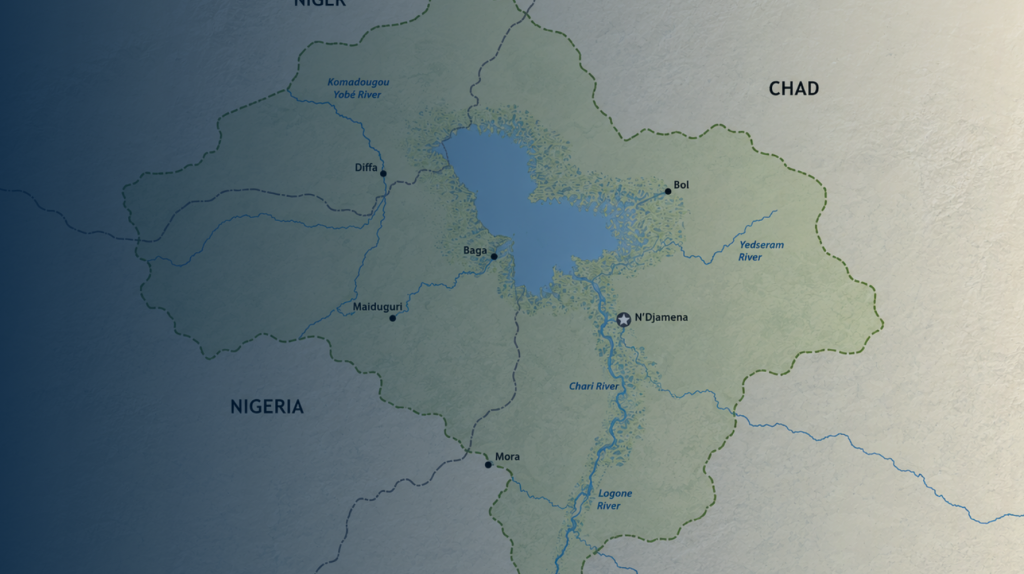
The Lake Chad Basin, where the borders of Niger, Nigeria, Chad, and Cameroon violently intersect, has become one of the most volatile regions in Africa. For over a decade, the international community has approached the crisis through the traditional lens of counter-terrorism, focusing heavily on the hard violent factors regarding the insurgency of Boko Haram. However, a strictly militarized perspective does not take into account an essential cause that multiplies the possibilities for violence in the region: the environment.
The region’s descent into violence is inextricably linked to perturbations in its geography. Lake Chad has historically been essential for the living of approximately 30 million people, relying most of them on agriculture, fishing, and livestock. Yet, due to severe climate stress and declining rainfall, the lake been reduced 25,000 square kilometers in 1963 to a mere 2,500 square kilometers in 2018. This ecological devastation has decimated local livelihoods, fostering deep socio-economic grievances, food insecurity, and mass displacement.
It is up from this cracked, infertile earth that extremism has flourished. As resources evaporate, competition for what remains intensifies, creating a perfect vacuum for radicalization. The environment acts as a threat multiplier, transforming vulnerable, disempowered populations into prime targets for terrorist recruitment.
A Tale of Two Factions: Exploiting the Ecological Void
While the original Boko Haram group, famously founded in the early 2000s, sparked the jihadist violence in the region, the insurgency fractured in 2015. Today, the region is terrorized by two primary groups: the original faction, Jama’atu Ahlis Sunna Lidda’adati wal-Jihad (JAS), and the Islamic State West African Province (ISWAP).
JAS relies on a brutal, indiscriminate violence against civilians, executing kidnapping or extortion. ISWAP, however, poses a far more insidious geopolitical threat precisely because it understands how to weaponize the environmental crisis. Learning from the Islamic State in the Middle East, ISWAP has adopted a pseudo-humanitarian approach toward Muslim civilians. By providing basic services, small monetary benefits, and “protection” in areas where local governments have failed due to environmental related resource collapse, ISWAP has effectively established relations of dependence with desperate local communities. They have positioned themselves as an alternative State, exploiting the environmental degradation to solidify their territorial control.
However, to reduce violence in the region, regional governments have trusted on two main strategies that have not achieved to really address the environmental causes of the terrorist recruitment. The primary military response has been a hard-military one: the Multilateral Joint Task Force (MNJTF), an African Union-mandated coalition of roughly 10,000 troops from the affected nations. While the MNJTF has had tactical successes in reducing the number of attacks and facilitating the return of some displaced persons, its heavily militarized approach fails to address the environmental causes of the insurgency. On the other hand, the Lake Chad Basin Commission (LCBC), a developmental institution established in 1964, has promoted a “Regional Strategy for the Stabilization, Recovery & Resilience” of the area. This strategy identifies the nexus between climate change, resource scarcity, and extremism, advocating for socio-economic recovery and peacebuilding alongside security. However, despite its forward-thinking framework, the LCBC struggles with slow implementation and lack of binding authority, leaving its environmental solutions disconnected from the immediate military realities on the ground.
Securitizing the Climate: A New Strategic Framework
To break this vicious cycle, geopolitical strategists must fundamentally reframe the crisis. The first step is the “securitization” of the environment. Currently, climate change in the region is largely treated as a matter of “human security” or a long-term developmental issue. Instead, policymakers must elevate the environmental collapse in the Lake Chad Basin to an immediate “territorial national security” threat.
By treating the drying lake with the same urgency as an invading army, regional states and international donors can bypass the bureaucratic inertia that currently stalls climate initiatives. When environmental degradation is recognized as the very mechanism allowing terrorists to capture and control sovereign territory, it forces a rapid mobilization of state resources, integrating ecological repair directly into military and defense planning.
Lessons from Colombia: Environmental Peacebuilding
Treating the environment as a hard security threat must be immediately followed by a long-term strategy of “environmental peacebuilding”. Here, the Lake Chad Basin can draw profound lessons from halfway across the globe: the 2016 peace agreement between the Colombian government and the FARC guerrillas.
In Colombia, the government successfully integrated former combatants into the environmental restoration of territories previously controlled by insurgents. This model achieved three crucial geopolitical goals. First, it stripped terrorists of the natural resources—like illegal plantations—they used to fund themselves, transforming those lands into protected community assets. Second, it provided a tangible pathway for ex-combatants to reintegrate into society through green jobs. Finally, it replaced illicit economies with sustainable local enterprises, such as cocoa agroforestry and eco-tourism, removing the socio-economic desperation that fuels recruitment.
This exact framework can be adapted for the Lake Chad Basin. Without waiting for a formal peace treaty, authorities can begin stabilizing the region’s hydrology—building reservoirs, monitoring groundwater, and improving soil retention—to physically remove the unpredictable geography that terrorists use to hide and move. Simultaneously, regional governments must implement reforestation and sustainable agriculture programs, directly employing vulnerable youth and surrendered militants. By restoring the land, the state removes the economic desperation that ISWAP so effectively exploits.
Conclusion
The tragedy of the Lake Chad Basin proves that the environment is no longer just a backdrop to geopolitical conflict; it is an active participant. The insurgency of Boko Haram and ISWAP cannot be bombed into submission so long as the dying earth continues to push desperate populations into their ranks. Achieving lasting peace requires a paradigm shift: regional powers must treat climate restoration as a hard national security imperative, utilizing environmental peacebuilding to reclaim both the territory and the loyalties of the people. In the Lake Chad Basin, saving the environment is synonymous with defeating terrorism.
Abel Juan Agut Rabadán, Analista Colaborador